In 1985, I developed a microprocessor controller under contract
for an industrial instrument manufacturer. I had
recently moved into a new home and decided that
a derivative of this design, with greatly
expanded I/O capacity, would be ideal as the
foundation for a centralized Home Automation (HA) system.
At the time, HA or "Smart Home" was an emerging concept and I
felt that building and installing a custom designed
system in my house would be a good weekend
project (though it quickly extended over many months).
Designated "SAGE" (a pet name I've used for
various other projects), I designed a single
board computer (SBC) based on the Hitachi HD6303
processor and added a large number of peripheral
devices to monitor and control a variety of
functions.
Ultimately, the SAGE HA project took about 2
years to install, largely due to an evolving
software platform and a huge amount of
hard-wiring throughout the house. Since then, the system
has been updated and expanded to include many features
which are locally and remotely controlled:
• Passive IR
sensors in all living spaces to detect
occupied rooms
• Automatic control of all lights based on ambient lighting & occupancy
• Multiple-zone, "learning" security system
based on occupant's lifestyle
• Programmable wake-up alarms,
alerts, and environmental lighting
• Programmable multiple-zone irrigation
systems with rain sensors
• Voice synthesized status messaging through a whole house intercom
• Voice command and control of lighting, HVAC, media components, and more
• Five zone intelligent heating/AC control via occupancy, voice, or smartphone
• Two weather stations with 5 and 20 year archives
• 24-hour monitoring of power usage, zone activity, HVAC, lighting, and more
• 10+ year graphical records of power use, weather data, AC usage details
• Multiple CCTV/DVRs linked to touchscreens and TVs in the house
• Built-in seismograph, RFID + fingerprint security, water leak & MTH sensors
• Secure LAN, smartphone, and Internet access to all HA features and CCTVs
• Dual fault-tolerant hardware, isolated solid state core controller
• Primary core engine is 100% assembly code for speed and efficiency
• Triple redundant power supply with UPS, on-board lithium batteries
The SAGE core SBC has been running continuously for 38 years (as of 2023) and experienced only a
single minor component failure (embedded video
processor chip) in all that time. Due to the
failsafe design of the hardware and software,
the original SBC has never crashed nor been offline.
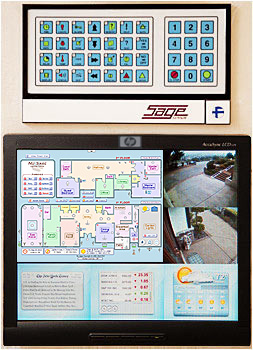
One of the SAGE access stations with the original
(legacy) control panel (top) above a touchscreen LCD
showing floorplan, CCTVs, and other daily info. Occupied rooms
and active lighting are continuously monitored and controlled.
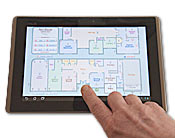
Remote access to lighting control
on a network connected tablet
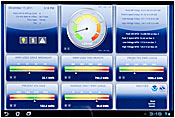
Energy usage summary via
integrated TED power monitor
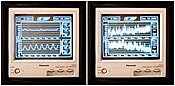
Indoor/Outdoor temperature
graphs - weekly and annual (Legacy, ca. 1986)
VIDEO: Demo of early voice control features (2013)
NOTE: Much has changed since this original video was made in 2013. Voice control and predictive response has been greatly expanded to include lighting scenes, HVAC, media components, security, irrigation, and more. Response times are also much faster due to improvements in hardware and networking since this video was uploaded.
ANABIC
Cypher
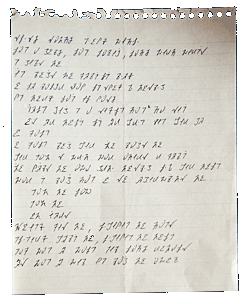
Bored during a first-year college class,
I began scribbling notes with a quickly conjured set of unique
graphemes and phonemes. The result was a
written language I called "Anabic".
Sadly, the class didn't get more interesting over the semester, so I
ended up filling several notebooks with everything from daily journal notes and poems to conceptual thoughts
and daydreams.
Page from a collection of
poems written in Anabic (1972) drafted during a particularly boring lecture.
IRIS 16
SBC
During my earliest days writing code for
microprocessors (way back in the 70's), I developed a preference for the
MOS and Motorola families of devices. So when the 68000
processor became available in 1980, I wanted to
be first in line to design a Single Board
Computer using Motorola's new 16/32 bit device.
I eventually designed and fabricated two versions of my
"IRIS" SBC, both using the 68000 but with
different amounts of RAM and I/O peripherals.
Version 2 was quite fast for the time, executing
the Byte Sieve in under a second (assembly code).
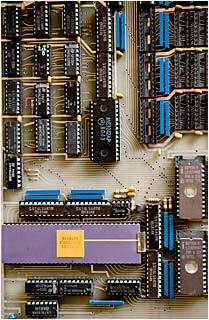
Processor and DRAM
controller section of IRIS-16 (ca. 1981)
Ternary
Logic TLU (Neural Nets)
The "holy grail" in computer science is
the refinement of artificial intelligence (AI).
Until very recently, developments in machine
intelligence have mostly been modest and
primarily limited to software techniques.
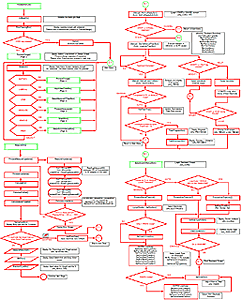
Back in the late 70's, I drafted a
theory combining a hardware neuron simulacrum (the TLU
or Threshold Logic Unit) with work on ternary
logic I had done earlier. Time constraints
prevented me and a colleague from building a prototype,
but we did run software simulations with
promising results. Today, neural nets are making a resurgence
in machine learning and AI is back in the news.